PPB Interview Questions
Who are you?
My name is Nico Wilkinson. I am a poet, artist, and organizer of the Keep Colorado Springs Queer open mic, and the founder of the Colorado Springs Queer History Archive. I've worn many hats over the years - touring spoken word poet, reproductive rights campaign organizer, letterpress printer and bookbinder, litmag editor, arts educator. I released my first full length poetry book, The Weeds Grow Anyway, last year in both a digital format, as well as a handbound linocut-printed limited release.
How does your identity inform your work on this project?
My queer and trans identity has inspired a great deal of the community work I've done in Colorado Springs over the years. It was the hostility I experienced as a queer poet that led to me founding the Keep Colorado Springs Queer open mic in 2016. It is my love for our natural world and the beautiful queer people I know that inspires a great deal of my poetry. As someone who loves old forms of printmaking, of putting the power of the word in the hands of the people, I am inspired by those who built movements and elevated their voices before a digital age, and ensuring that those efforts, as well as the ephemerality of digital art and activism, is preserved.
When did you start this project?
I started this project in November, 2025. I had just finished my work on a recent gallery exhibition, Spreading the Word(s): The Poetry of Activism, at the UCCS Heller Center and sold out of the last of my book, The Weeds Grow Anyway. I was in that haze I often find myself in when a project ends in which I don't know what to do with myself. I met with Monycka Snowbird of Sweetgrass Advocacy, as a part of my work as Outreach Coordinator at Inside Out Youth Services, to discuss ways our organizations could support one another. We spoke for a few hours. She was telling me about her work of uncovering stories of missing and murdered indigenous people, and recovering the remains of indigenous people whose bodies had been stolen and displayed in various locations around Colorado Springs. She also told me about organizations that were around in the 90's and early 00's that were doing LGBTQIA2+ advocacy, such as Ground Zero. It occurred to me, as someone who had been living and organizing in Colorado Springs for over a decade at that point, that there was so much I did not know. So many stories that were being swallowed, both by the passive force of time's passage, and the active forces of fascism that seek to erase certain people and stories. I was inspired by Monycka's work and knowledge to unearth the stories of her community's elders, amazed that someone in the present, through intensive research and perseverance, could recover stories and knowledge that might otherwise be lost to time. I started to wonder, who was doing the work here in Colorado Springs before I and my other queer contemporaries arrived here?
After that conversation, I began my research, which I have tracked in a published online notebook. Since November, I've scoured various archives and dead webpages, I've sent messages to strangers, asked questions in various Facebook groups. I soon learned there is an abundance of knowledge and stories of queer people who did important work here in Colorado Springs, many of which are either not indexed with major search engines, hidden behind institutional paywalls, un-digitized, and many stories not previously archived at all. I quickly realized that the past and the present will be lost to time if we do not work to preserve these stories, and not just preserve them, but make them accessible. Otherwise, how will people appreciate and honor those that lives, worked, and advocated for a better life here, not just for themselves, but for those to come.
What are useful ways others could pitch in on this project?
There are so many ways to get involved. People who are passionate about this work and want to take an active role in it are encouraged to join the Lambda History Committee, which meets bi-weekly to collaborate on research and organize archive collection events. People can also sign up for our newsletter to stay updated on upcoming archive events and research. People can also contribute to the archive via the online contribution form. We are taking digital and physical contributions of materials related to Colorado Springs Queer History and Culture, both past and present.
Is there a time period or other specific area of local queer research you are particularly interested in?
When I started reviewing archived materials at PPLD, specifically issues of GAYSPEAK, the Pikes Peak Gay Community Center's newsletter, I found myself particularly struck by the impact of HIV/AIDS on the local community.
This section was published in the September, 1982 issue:
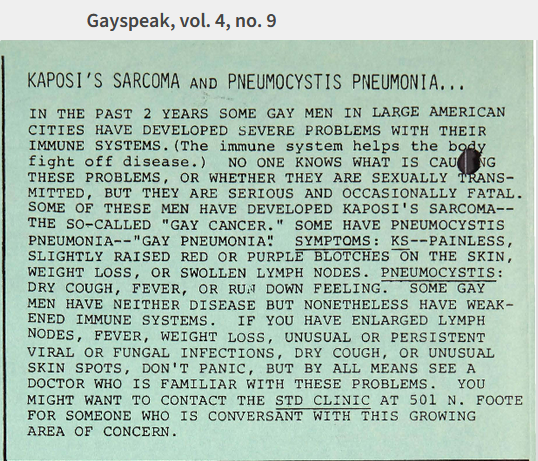
It provided a glimpse into a moment before HIV/AIDS had a name. It reminded me of the last few months of 2019. Of the horrifying uncertainty we were all suspended in as we held our collective breath.
As I continued reading through issues of the newsletter, I found mentions of and an interview with a man named Ricky Morris. He was a bartender at The Exit, one of the first gay bars in Colorado Springs. He was HIV+. Personals popped up in GAYSPEAK, desperate pleas to the community to offer what support they could. Gazette Journalist Catherine Terwilliger wrote a multi-page story in which she documented Ricky during his final months of life. In the article, he is quoted as saying:
"I don't see anybody anymore - just a few people...And I'm a little fearful, too. I don't think anybody would be mad at me or anything, but when I was first diagnosed and went out, the fear and panic in people's eyes was more than I could handle...I guess the thing I miss the most is being active in the community the way I was; I just miss all my friends."
Ricky's words remind me of sentiments I've heard expressed by those whose lives have been significantly impacted by long COVID today. While my experience of long COVID is nowhere near as dire as the experience of HIV+ people in the 80's, I know people who have been rendered unable to leave their homes due to COVID's long-term impacts on their bodies and immune systems. People whose lives have been taken, figuratively and literally, by COVID. Its impacts have led me to live a different life than I once did pre-pandemic. That is why I only organize masked events now, because I know there is a significant number of people who feel isolated from once-safe spaces due to the harm and risk posed by the ongoing pandemic.
It was surreal to hear such a familiar reflection of loneliness echo across the decades. It also made me so grateful for the treatments available today for people who are HIV+, so that it is no longer the death sentence it once was.
Ricky Morris passed away from AIDS on November 2, 1985 at the age of 32. Cate Terwilliger's article, RICKY: Life and Death with AIDS was published in the November 17, 1985 issue of The Gazette. He is memorialized in the AIDS quilt, on a panel stitched by Barb Granniss and Cher Pennington.
The AIDS epidemic led to the founding of S-CAP, the Southern Colorado AIDS Project which continues today as the Southern Colorado Health Network. It also led to the founding of Lambda House, a home on the westside in which HIV+ people could live and receive care. I have a deep admiration for the work of activists during such an uncertain time, especially the lesbians who took care of the sick and dying. That has been an interesting recurrence through my research: that the lesbian community so often came through for the gay rights movement, and for the gay men who were dying of HIV.
There are so many interesting stories from across the decades. I recommend people check out the pages about Barbara Grier, gender outlaws from around the turn of the century, the Gay Liberation Front, and the Lambda Services Bureau.
I also feel passionate about unearthing trans histories, as those are particularly difficult to find.
It is also maybe worth noting that so much happened in Colorado Springs in the 90's due to the response to Amendment 2 that I've barely been able to scratch the surface of that decade yet.
Anything Else You'd Like to Say
I want to ask the person reading this, especially if they're part of the LGBTQ+ community, to see themselves as a part of history, as someone with a story worth preserving. It might feel egotistical to do so -- I feel egotistical when I take steps to archive and preserve my own work -- but then I think about how many people of the past I desperately wish I could find more information about, but whose voices elude me. They might not have known that a day would come in which a researcher would be seeking out their stories, inspired by what little was left behind.
One day, the future may come knocking. I am asking you to take steps now so that your story may answer. With all the queers who have yet to arrive in mind, I implore you to contribute to the archive.